skip to main |
skip to sidebar
A group of serious walkers has just gone down the Lane. Twenty or so of them, all in expensive walking boots, maps round their necks, a variety of hats as befits the warm, sunny day, all with fancy sticks - some with two, some with one. My goodness me, walking these days is really serious stuff.
I watched them pass and it reminded me how we have got out of the habit of walking because we have to; our walking now is mainly done for leisure activity. Alright, we might walk two hundred yards down the road to catch a bus, or if we live in a town we might walk a few hundred yards to go to the corner shop, but on the whole we don't walk any more. We have no need.
And I thought of my father who was a great bowls player and who used to walk with my mother and me after work three or four nights a week (work from 7am to 5pm, dinner, an hour in the garden, a wash and then a two mile walk) to play Crown Green Bowls. This was in the days of Double British Summertime (i.e. the war years) and it never seemed to get dark. We would be walking back in the dusk at 10 o'clock and I would be late to bed. But at least my Father went to work on the bus. We never had a car and he never learned to drive.
My grandfathers would no doubt have walked even further because that was the only way most working people got from A to B - and certainly in the case of my grandfathers they would do physical work all day and then walk home - and think nothing of it.
With each succeeding generation the need to walk has got less and less until now walking seems to need all the fancy gear. Yet see television pictures of some of the Third World countries, particularly those in Africa and you see women walking miles and miles to market or to collect water. You see men walking sometimes hundreds of miles throughout the dry season to find water for their cattle and you see children, often hungry for education, walking a dozen miles to school every day.
Now, without a second thought, we tend to back the car out of the garage just to go a short distance. The times they are a'changin' as Bob Dylan famously said in quite different circumstances.
Friend S, who reads my blog regularly although she doesn't blog for herself, says she enjoys my blog more on the days when I write about what is happening on the farm - so I thought I would bring farm life up to date.
All the sheep have gone back on to the fells and the fields are largely empty except for a small group of dry cows, who are let out every day to enjoy the sunshine and then taken in at night. While the fields are empty they have all been harrowed, rolled, fertilised with 20:10:10, slurried and now left for the grass to grow (which it is doing with the sunshine we have had over the past few days.)
All the fences damaged by wind or water over the winter months have been repaired and are now in good order, and all the stone walls have also been checked for damage and repaired.
We still have a loose-housing barn full of in- calf cows and they are staying in for a little while longer as they are to be freeze-branded one day next week and it is easier to have them all 'captive' for that operation. It is not at all painful and every one ends up with a number stamped on its rear end so that it is easily identified.
In a couple of weeks time sheep and lambs will come into the big pasture and heifers for fattening into the other pastures. Then the rest of the fields will be left to grow until they are ready to be cut for silage. This operation will be late this year because the weather has been so cold.
Today the catch has broken on the loose-housing door so the farmer is busy welding it together again as I write this. Once the cows found out that they could push the door open they would be out and away into the fields - they can already smell the grass growing and are getting restless.
Following on from the cucumber theme:
I am very busy at the moment and life is quite hectic, so time for blogging is short. But here are a few ideas which give more food for thought on the business of writing.
Morning AJ (on my side bar) talks of studying to be a journalist and learning to be concise before going to University and having to be writing longer essays and thus having to learn to expand that conciseness. That's an interesting reversal of the process.
In the Times magazine yesterday there is an interesting article about John Le Carre, in which says says - "The cat sat on the mat is not a story, but the cat sat on the dog's mat is the beginning of a story."
Another lovely story in the article is about his dislike and distrust of George Bush (re the Iraq situation) - apparently he still has a rubber figurine of Bush in his bathroom so that he can stare at it while urinating. I would guess that most of us could think of somebody we could have a figure of in our bathroom, even if only metaphorically.
And I did like Cro Magnon's comment on my previous post that Yeats always got his friend Lady Gregory to look through his work and suggest words he could eliminate without altering the meaning.
Anything that Yeats did is good enough for me - I don't know about you. Have a good week-end.
There is an interesting article in Times 2 today (by Richard Morrison) about a book by Malcolm Gladwell. The book is called
"Blink" and Gladwell is a New York journalist.
In the book he contends that the whole of life is like a cucumber - you don't have to eat the entire cucumber in order to know what cucumber tastes like. You really only need a slice to decide whether you like its texture, taste and juiciness. Then you can make up your mind whether you like cucumber or not.
He suggests that your first impression of anything - people, works of art, music, books, is almost always the correct one for you. He suggests that this is because your brain can process signals very quickly and come to a real assessment.
Because of this view there is an annual competition called Virgin Media Shorts which has been going for six years and which challenges anyone who would like to be a film director to show viewers what they can do in 140 seconds or less.
I think this can probably be translated to other disciplines too. I read his article for exacly 140 seconds and managed to get to 300 words. I think it would be possible to say something "amusing, beautiful, wry, political or profound" (to quote Morrison) in 300 words - in fact in a lot less.
I think it could also be used in a musical composition - not sure about visual art though - may be it would take longer - although I do think some Picasso drawings which are inspirational probably took hours to think about and only a short amount of time actually putting pen, pencil, charcoal or whatever to paper.
When I think of some of the turgid books I have tried to read; books which have a message but which lose me after a couple of chapters because I become choked with a mass of words I definitely think it would be worth a try. What do you think? Do you fancy having a go?
Poet in residence (on my side bar), Gwilym, reminded me in his comment, about a lovely cafe in Morecambe. That jogged my memory on another lovely cafe and I have been sitting here at the computer day dreaming about a lovely day about thirty years ago - so I thought I would share it with you.
We had dear friends who lived at Chorley in Lancashire and we spent weekends with one another over the years. One weekend when we arrived F had a list of all the possible places to go for the day on the Saturday. One of these places was Blackpool and in passing I said I had not been there since I was a small child and I wondered if it had changed. So to Blackpool we went.
If you are a U S reader you will probably never have heard of Blackpool but it is an "in-your-face" seaside resort on the West Coast, noted for its Tower, its brashness and its illuminations. It was illuminations time.
The place was crowded and we struggled to find a Parking Place, but eventually we found one and we had the most wonderful day.
First of all we went into a really old-fashioned cafe where the waitresses were all middle-aged, rather stout ladies and all dressed in black dresses and white frilly aprons and caps. Every table had a starched white cloth on it and all they served was fish and chips; but what fantastic fish and chips - freshly caught, crisply battered and served with plates of white bread and butter and a pot of good, strong tea.
Then we walked along the beach, picking up sea shells, looking at the children building sand-castles, waiting for the light to fade so that the illuminations would come on - and then we returned the other way in a horse-drawn carriage so that we could look at the illuminations. What a splendid day that was.
It is a poignant memory now because F has been dead for many years and his wife, C, has lost her memory and will remember none of it. Incidentally F's favourite word was 'splendid' and I used it here without thinking - I never use the word without thinking of him either.
This is how people live on isn't it? My husband at the time has been dead for twenty two years too, so I am the only one carrying a memory of that super day out. And when I die, so will the memory but for now I have to say that every time I think of it I get a feeling of great pleasure. So thank you Gwilym for jogging my memory.
On a completely different topic - the farmer is busy mending fences. For the time being the weather is quite clement and the floods at the end of last year, coupled with several severe gales over the Winter, have played havoc with some of the wooden fences - so it is time to mend them before any of the animals go out.
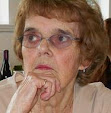
PS I have updated by profile picture so you have one taken only about two years ago when I am looking more my age!
One of the most evocative sounds here at this time of the year is the call of the Curlew. The largest of our native waders, you are likely to see it on any beach after the tide has gone out. But when it comes to nesting time a lot of curlew like to nest in our fields and they are already beginning to stake their claims. That 'coorwee,
coorwee sound echoes round the fields as I walk round with the farmer.
The trouble is that this year the grass is very slow to grow and is nowhere near ready for a curlew to build a nest, so I do hope they have the sense to wait a bit longer. The chicks are so vulnerable when they first hatch out and are the size of a large bumble bee on long legs - one heavy rain storm and they are suffering, so they really need the shelter of the long grass to survive. There have been times when the farmer has discovered a nest just as he was about to begin silaging and has fenced the nest off with an electric wire to give the birds a chance.
Another bird which nests in the grass is the lapwing with its distinctive 'peewit' call. It is such a beautiful bird and apart from its high-pitched 'pee-wit' call we hardly notice it but a few usually nest in our marshy field.
Lapwings are a bird of lowland and marsh and are a common bird in Lincolnshire, where I originate. There they are coloqually called either tyrrwhit or pyewipe and in both cases have an inn named after them.
Birds are an important part of our lives here on the farm and we watch for them coming at their time each year. This year we still have only two swallows in the barn - most years we have twenty or thirty by now. And as yet there are no house martins in the eaves of the farmhouse - if they don't arrive I shall miss them greatly.
By definition, a weed is any plant which is growing in the wrong place; although I would qualify this by saying that any Viola Labradorica or Asperula Odorata which chooses to seed itself between the flags on my patio is made very welcome.
Perhaps the commonest and certainly the most disliked among these weeds is the Dandelion. I have always thought it a pity that the Dandelion is seen as a weed, because if you look closely at it , it really is the most beautiful flower. And at around this time of year it borders almost every road and lane in the country. But, sadly, it is also one of the cleverest at spreading its seed. By making that pretty pom-pom head and waiting for a breezy day, it ensures that its offspring float over a wide area and mostly take root. One of its favourite rooting places seems to be in my lawn, where it pushes down its tap root far too deep to be persuaded to come out and I have to resort to a tiny spot of weedkiller in the crown.
But that is an easy job compared with getting rid of those two other weeds which RS Fitter in his wild flower book calls 'unauthorised wanderers.'
How I welcome the Celandine when it first opens its shiny yellow face to the sun. And I continue to enjoy it when it grows along a bank or a hedge-side out in the fields. But when it takes up residence in my tulip bed, making a delightful yellow carpet for the bright red tulips, I draw the line. 'Enjoy it while it lasts and then when I lift the bulbs I will get rid of it,' I think.
Ha! 'You and whose army'? I hear my father saying. It is quite shallow rooted but each root has hundreds of follicles and leave one in the ground and that is quite enough to get it going again for next year. Yes, I am afraid the message is that if you have Celandines then enjoy them and make the best of it.
And please.......don't get me started on Ground Elder.
April 27th
A male pheasant has become the avian equivalent of a Property Tycoon here on the farm. He has taken over the garden, the lawn
under the Scots pines and the back patio and would like to take over the house as well if he could.
He is not friendly. If we go outside into the garden he demands an explanation for our conduct. I hear his raucous voice almost immediately; in fact I hear it dozens of times a day.
He is fat, sleek and in full breeding colours and has a harem of six ladies who are gradually disappearing, presumably to make nests in the bedgeback.
It doesn't seem to occur to him that he has us to thank for his appearance. He has scavenged under our bird feeder all Winter long and spends most of the day there, eating the corn the farmer puts down for him and then waiting for the birds at the feeders to drop various seeds for his delectation.
Should another cock pheasant dare to land on the grass he is totally unforgiving. One fight resulted in the other pheasant being lamed badly. He is slowly recovering and tries to sneak in for a feed if the boss is out of sight - but he never succeeds. There is a furious shriek and he takes flight and is gone.
The dogs and cats give him a wide berth. In fact, the only thing that could bring about his downfall is a vehicle of some kind. He spends a lot of his day strutting his stuff up and down the lane and I fear that one day he might pay too much attention to vanity and not enough to listen out for a car coming.
Taking your advice to heart I have written about what is familiar to me; what I know most about. I have written a Nature Diary entry. It is one of the first things I read in the newpaper every day. In the days when I took the Guardian it was always William Condry I enjoyed reading. In the Times it is Derwent May. So here is one possibility for Wednesday's Writers' Meeting. I may well write several more before the day and choose that I like the most. By the very nature of the entry it has to be short - so this one is under three hundred words. What do you think?
Winter pays an unwelcome visit this morning, and - like an uninvited guest who turns up at a party- we try to include it in whatever we are doing and pretend we don't mind.
The blackbird continues to forage on the lawn and in the hedge back for the final touches to the nest; the weeping cherry, whose blossoms are just emerging, looks as though it wishes it had waited for another week; I put on a couple of extra layers and venture out into the garden to replant a stone trough I emptied yesterday.
Just to emphasise its arrival, Winter chooses this moment to throw down a sharp, sleety shower and I hasten indoors, preceded by the black farm cat who does his level best to trip me up and reminds me that he has just eaten a baby rabbit and that eating rabbits is thirsty work. His friend, the cream farm cat, who is far too shy to show himself, waits round the corner to share the saucer of milk they know I will put out.
Once again Spring is on hold. Not for the first time this year the sheep shelter with their new-born lambs up against the stone walls. Once they get a good feed of their mother's milk these hardy fell lambs will stand everything that Winter throws at them now that April is here and it is not long before the lambs can't resist a dash up the field. They run in a flock to the far side, stand a minute and then run back - just for the sheer joy of it.
Yes, Winter has returned and the North wind has picked up - but surely this is its dying gasp - the sun is high and it has some warmth in it and sure as night follows day the Spring will win in the end.